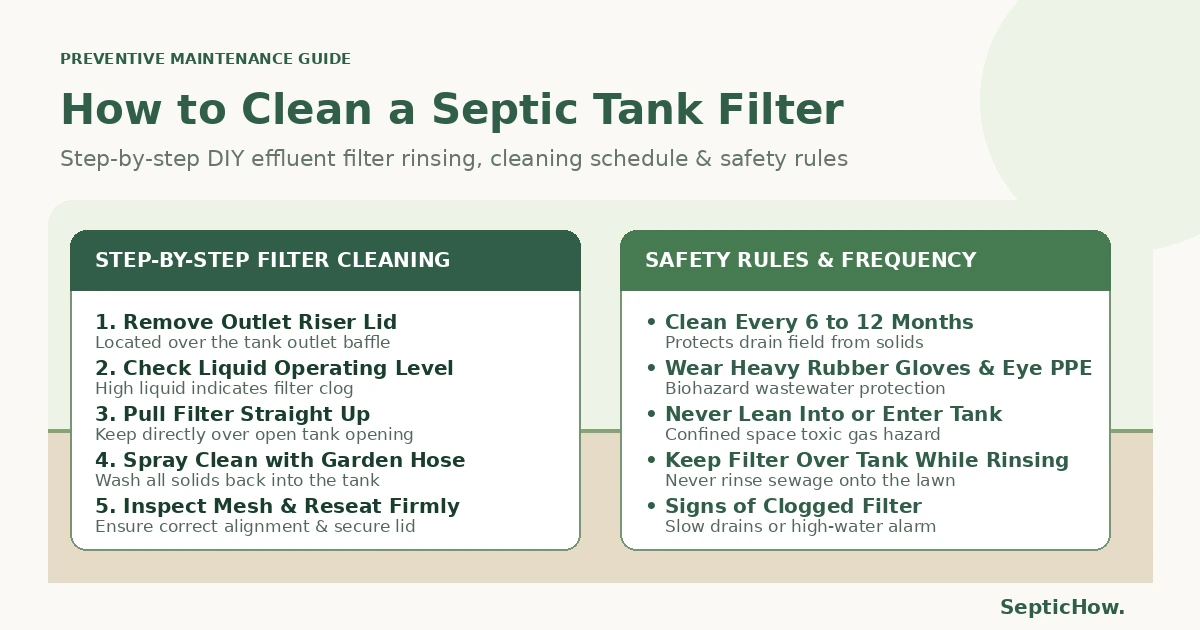
An effluent filter protects your septic drain field by catching suspended solids before wastewater leaves the tank. Filters require inspection and cleaning every 6 to 12 months. Because opening septic tanks involves hazardous sewer gases and fall risks, servicing is safest when conducted by a qualified septic technician during routine maintenance.
What is a septic tank effluent filter and what does it do?
An effluent filter (or septic tank filter) is a cylindrical slotted plastic screening cartridge installed inside the outlet tee of your septic tank. Its essential function is to serve as a physical barrier, capturing suspended hair, laundry lint, and fine solid particles before clarified liquid wastewater exits into your soil absorption field (drain field).
Without an effluent filter, fine suspended particles gradually migrate past the outlet baffle into the underground distribution lines and absorption trenches. Over time, these solids settle into soil pores and accelerate the growth of a dense, waterproof anaerobic biomat layer, causing premature drain field failure that can cost $10,000 to $25,000 to replace.
According to Purdue University Extension (HENV-105-W) and EPA onsite wastewater guidelines, effluent filters are now standard in modern sanitary codes for new and repaired systems to dramatically extend drain field lifespan.
Critical safety warnings: Why opening septic tanks is dangerous
While cleaning an effluent filter may sound like a simple household maintenance chore, accessing a septic tank presents severe, potentially fatal hazards that require professional training and specialized safety protocols:
• Lethal sewer gases: Anaerobic decomposition inside septic tanks produces toxic gases, primarily hydrogen sulfide (H2S) and methane (CH4). Hydrogen sulfide paralyzes the human olfactory nerve at concentrations as low as 100 parts per million (ppm), meaning you lose the ability to smell the gas right before losing consciousness. Inhaling high concentrations can cause immediate collapse and asphyxiation within seconds.
• Deep fall and drowning risks: Access risers can be 2 to 5 feet deep leading directly into several feet of liquid waste. Stepping onto an unsecured lid or leaning over an open hatch presents severe fall, blunt injury, and drowning hazards for adults, children, and household pets.
• Pathogen exposure: Untreated residential septage contains hazardous biological pathogens, bacteria, and viruses that can cause severe illness through skin contact or aerosolized droplets.
Because of these life safety risks, homeowners should never lean their heads into an open tank, enter a tank under any circumstances, or perform work around open risers without proper equipment. Effluent filter servicing is safest when delegated to a licensed septic contractor or trained service technician.
How often does an effluent filter require maintenance?
Wastewater engineers, extension publications, and filter manufacturers (such as Polylok, Zabel, and Sim/Tech) recommend that effluent filters be inspected and cleaned every 6 to 12 months under standard single-family residential use.
Several household factors accelerate solids loading and require more frequent servicing (every 3 to 6 months):
• Large household occupancy or frequent houseguests generating elevated daily wastewater volumes.
• Heavy weekly laundry use, which sheds millions of non-biodegradable synthetic textile microfibers.
• Kitchen garbage disposal use, which introduces ground organic food scraps that do not settle readily and increase solids loading by 30% to 50%.
At an absolute minimum, homeowners must ensure their service contractor pulls, evaluates, and thoroughly cleans the effluent filter during every routine 3- to 5-year septic tank pumping service.
How qualified professionals inspect and service an effluent filter
Understanding how a certified septic technician services an effluent filter helps homeowners verify that their system is being maintained correctly:
A licensed contractor typically follows these structured service steps:
- 1. Secure the work perimeter: The technician ensures bystanders, children, and pets remain well away from the service area.
- 2. Remove the riser cover safely: Using appropriate tools, the technician unbolts the safety lid while standing upwind to allow trapped volatile sewer gases to dissipate into outdoor air.
- 3. Inspect the liquid operating level: Before moving the filter, the technician evaluates the liquid level in the tank. If effluent is standing higher than the outlet tee pipe, the filter is occluded with solids.
- 4. Extract the filter with an extended reach tool: Standing firmly on stable ground outside the riser, the technician uses a pull rod or retrieval handle to lift the filter cartridge straight up, keeping it positioned directly over the open tank.
- 5. Wash solids back into the primary compartment: Using a garden hose with a controlled nozzle, the technician sprays the filter thoroughly, directing all dislodged solids, lint, and hair back into the septic tank where it can settle. Solids are never washed onto the lawn, flowerbeds, or driveway.
- 6. Inspect the cartridge for damage: The technician examines the plastic mesh or bristle elements for tears, distortion, or bypass gaps. If the cartridge is damaged, it is replaced immediately.
- 7. Reseat the filter firmly: The clean cartridge is lowered back into the outlet tee and pushed firmly into its locking collar to ensure wastewater cannot bypass the filter.
- 8. Re-secure the safety lid: The technician reinstalls the riser cover and tightens all tamper-resistant safety screws to eliminate fall hazards.
Warning signs of a clogged septic effluent filter
When an effluent filter becomes occluded with trapped lint and solids, liquid wastewater cannot exit into the drain field. This produces distinct household warning signs:
• Sluggish drainage or gurgling in ground-floor toilets, shower pans, and sinks across the entire home.
• Abnormally high liquid levels inside the septic tank upon opening.
• Audible high-water alarm activation on septic systems equipped with an effluent filter float switch.
If your plumbing suddenly slows down across multiple rooms, never dump caustic chemical drain openers into your toilets. Contact a licensed septic professional to inspect the effluent filter and outlet line.
Frequently asked questions
Where is the septic tank filter located?
The effluent filter is installed inside the outlet tee (the exit pipe) of the septic tank, located beneath the access riser closest to the drain field.
Can I run my septic system without an effluent filter?
Never remove an effluent filter and leave the outlet open. Running a system without a filter allows suspended solids to flow directly into the absorption trenches, which rapidly causes catastrophic biomat clogging and drain field failure.
How much does a replacement septic filter cost?
Replacement filter cartridges typically cost between $35 and $85 for parts, plus service technician labor if installed during a routine inspection or maintenance call.
Why should homeowners not clean the filter themselves?
Opening septic tank lids exposes you to toxic sewer gases like hydrogen sulfide, which can cause sudden unconsciousness and death, as well as severe fall and drowning hazards. Licensed professionals have the proper safety equipment and training to service the filter without risk.
Sources you can check
EPA — How septic systems work ↗
Septic tanks and soil treatment · Checked 2026-10-20
EPA — How to care for your septic system ↗
Maintenance and household water use · Checked 2026-10-20
Purdue Extension — Operating and Maintaining an Effluent Filter (HENV-105-W) ↗
Effluent filter purpose, maintenance frequency, and safety precautions · Checked 2026-10-20