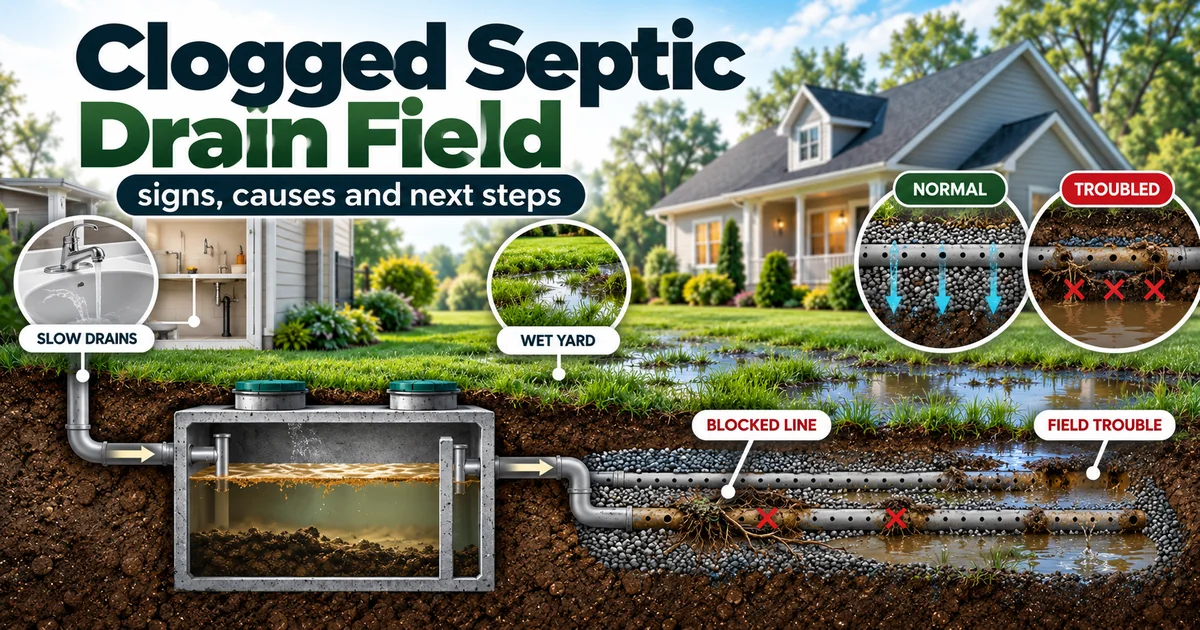
Slow drains, odors, backups and wet soil can point to a septic drain field problem, but the cause may also be a clogged house pipe, blocked outlet or pump failure. Avoid DIY chemicals and digging; a professional needs to identify the restriction and check the soil treatment area.
Signs a septic drain field may be clogged or overloaded
Watch for repeated sewage backups, gurgling, wastewater odors, surface wetness and unusual grass growth above a known field. These signs do not diagnose one component by themselves.
Wet grass after a storm may have several explanations. Sewage surfacing or entering the house is more urgent: reduce water use and keep people and pets away.
What causes septic drain field problems?
Possible causes include excessive solids escaping the tank, blocked distribution components, unsuitable or saturated soil, heavy water loads and physical damage from traffic or construction.
A missing maintenance record is not proof that the field has failed. Ask for a system assessment rather than relying on a single symptom or an online remedy.
Blocked septic pipe or failed leach field?
A restriction in a house drain or sewer line can create slow drains and backups. A pump malfunction can produce similar symptoms in pressure-dosed systems. Field failure concerns the soil treatment area's ability to accept and treat wastewater.
A professional may examine tank liquid levels, pumping equipment, accessible distribution points and field conditions to determine the next step.
| Possible fault | Typical professional check |
|---|---|
| House drain blockage | Fixture and shared drain assessment |
| Tank outlet restriction | Accessible outlet and filter inspection |
| Pump failure | Pump, float and control diagnosis |
| Drain field malfunction | Site and soil treatment evaluation |
What NOT to pour into a clogged septic drain field
Avoid drain cleaners, solvents or additives marketed as guaranteed field restorers. Such products are not a substitute for professional diagnosis and may harm system performance or the environment.
Do not dig into the field or attempt pressure cleaning buried lines without qualified help. Buried utilities, wastewater and unsafe tank openings present hazards.
What to do before scheduling drain field repairs
Gather the system drawing, last pumping date, recent repair history and notes about heavy rain or household occupancy. Ask the contractor to itemize recommended work and explain whether permits are needed.
If replacement is suggested, ask whether a correctable component fault has been ruled out and obtain a local, site-specific design and quote.
Clogged pipe versus failing soil treatment
Slow drainage may be caused by a fixture clog, house sewer blockage, septic tank outlet restriction, pump malfunction or a failing drain field. Symptoms alone cannot determine which one is responsible. A technician should examine the tank, accessible distribution parts and field conditions before recommending treatment.
Avoid chemical drain cleaners, improvised additives and digging into the field. Keep heavy vehicles away and record recent rain, water use and which fixtures are affected. After service, request written findings and ask what signs would mean further evaluation is needed.
Why wet grass and slow drains need context
Lush grass above a drain field can have several explanations and does not alone prove failure. However, wastewater odors, persistent soggy soil and backups together make professional evaluation more urgent. Keep people and animals away if wastewater may be present.
Slow drains may originate inside the house or at the tank outlet. Describe whether one fixture or multiple fixtures are affected and whether the symptoms change with rain, laundry or other high water use.
What a contractor may inspect
The contractor may review the service record, inspect tank access points and filters where appropriate, test pumps or alarms on equipped systems, evaluate distribution components and examine site conditions. Different faults require different repairs.
Request an explanation of the diagnosis and whether the soil treatment area itself has failed. If replacement is recommended, discuss the local approval process and ask for an itemized scope.
Things that do not reliably unclog a failed field
Household chemicals and advertised bacteria additives cannot be assumed to restore a damaged or overloaded soil treatment system. Excavating, injecting fluids or pressure-cleaning buried pipes without qualified evaluation can create safety and environmental problems.
The most useful homeowner actions are limiting water use when symptoms occur, keeping vehicles off the field and arranging a professional evaluation. Continue regular inspections and pumping after any repair.
Frequently asked questions
Can pumping a tank unclog the drain field?
Pumping removes solids from the tank but does not necessarily restore blocked distribution lines or saturated soil.
Will a clogged drain field dry out on its own?
Surface moisture may change with weather, but recurring sewage or drainage failures require assessment; do not assume a failed system has repaired itself.
Should I use septic additives to unclog the field?
Do not rely on additives as a repair. Ask a qualified professional to identify the cause.
Sources you can check
EPA — How septic systems work ↗
Septic tanks and soil treatment · Checked 2026-10-05
EPA — How to care for your septic system ↗
Maintenance and household water use · Checked 2026-10-04
EPA — Resolving septic system malfunctions ↗
Warning signs and professional assistance · Checked 2026-10-04